Search
Search the entire page content.

Have you ever considered what brings value to your company and saves time? In this extensive article, we will compare the time and costs of hiring in-house versus externally through an agency. Although the data used is from older periods (when the demand for people was enormous and salary costs were not as high as they are now), it is applicable long-term, regardless of the current situation in the labor market.
Not all agencies are created equal. Most recruitment agencies charge a fee for placing a candidate within a company. You only pay after you've signed a contract with the chosen applicant. But have you ever considered how much money your company spends on the preliminary screening and interviewing of unsuitable candidates that agencies send your way? Employers often assume that by using a recruitment agency, they will get more candidates, thereby saving money and time. However, have you ever analyzed the actual costs associated with hiring employees through an agency?
Internal recruiter or recruitment agency? What do you choose when hiring a new reinforcement for the team? Let's see how these options translate into costs.
Example:
Company XY (from the manufacturing/engineering sector) is looking for a „CAD Designer“ with a salary of, for example, €1500 per month. They have 12 similar recruitments annually.
Example interviewer costs:
– Recruiter – 11 $ per hour
– Senior Design Engineer – 13 $ per hour
– Design Manager – 17 $ per hour
Note: Salary information and all these figures are from the „Salary Survey 2015 – Czech Republic“ by a major recruitment agency. The exchange rate was 1 USD to 25 CZK.
Hiring with an internal recruiter
Keep in mind that even if you plan to use an agency's services, your recruitment team will still be doing the same job, hiring for all open positions, working on the company's „brand,” managing referrals, etc. You will also need to perform pre-screening for candidates sourced from channels other than agencies. We will not address extraordinary costs in this case, as they can vary depending on the company's hiring process, etc.
Your Time and Costs (Example):
– writing a job description,
– advertising (LinkedIn, job portals, etc.),
- CV databases,
– brand marketing (flyers, advertisements, etc.),
Premium LinkedIn account.
Process (example):
– preliminary selection of candidates,
– preliminary screening of candidates,
– sending profiles to the hiring manager or team,
– first round of interviews, ,
– second round of interviews,
– offers, rejections,
– communication with the team and candidates.
By using a recruitment agency, you’ll attract more candidates and reduce the time it takes to fill an open position. However, you’ll still need to write a job description, post the position on LinkedIn, and do everything else you would if you were handling the recruitment yourself.
However, when you engage an agency, you need to consider additional costs, such as your time and your team's time that you must spend with the agency and its candidates for interviews, plus the agency's success fee in the form of a hired employee.
Costs associated with using an inappropriate agency
If you use an agency that sends you many resumes every week, it looks good in year-end statistics, but what is the reality of the actual costs in this case?
Example:
Your company opens one position each month with the same profile, so you hire 12 people annually and use the services of two agencies:
Agency A An agency where recruiters have a quota to present at least five profiles per day to their clients. As one of the clients, you will receive approximately 15 profiles per month. That's 180 per year!
Agency B An agency where recruiters focus on quality, not quantity. So you get two to three profiles per month. So that's 36 profiles per year.
Costs shared by both agencies:
Agencies A and B – your time for pre-selection + pre-screening time + interview time + acceptance/rejection time + time for communication with agencies and candidates after interviews.
Agency fee – The placement fee depends on the starting salary. In the Slovak Republic, the fee ranges from 1.5 to 3 times the candidate’s monthly salary.
Cooperation with agency A
This example shows what a year-long collaboration with agency A could look like. If you have 180 profiles, a recruiter will review them and share feedback with the agency.
– The recruiter will perform an initial screening of 120 profiles.
– 80 of them will go to the HR manager with feedback.
- 45 of them will be invited by a recruiter for an on-site interview.
In the first round, there will be 45 interviews.
In the second round, 15 interviews will be conducted.
Six offers will be presented in the result.
You can see the total financial and time costs of using Agency A's services in the following table:

It is very important to remember that a bad hiring decision will always be more expensive for your company than hiring the right candidate. Therefore, carefully consider who you entrust with this task.
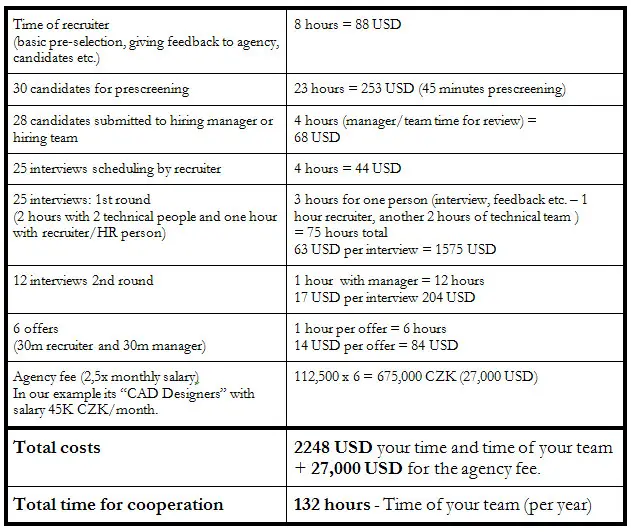
Cooperation with agency B
The recruiter will perform a preliminary check of 30 of them.
– 28 of them will go to the HR manager for feedback.
– 25 of them will be invited by the HR professional for a personal interview.
In the second round, 12 interviews will take place.
Six bids will be submitted.
Let's look at the time and financial resources spent in this case:
Evaluation
The financial difference between agency A and B is $2360. This might be a negligible amount for large companies, but if you're using the services of six agencies and four of them operate like agency A, that's $9440 plus agency fees.
You also have to consider the time that the right agency will save you and your team. In this example, we are talking about 150 hours. This is the difference between working with agency A and agency B! And with four „A“ type agencies, your team will lose about 600 hours annually.
I know some readers of this article will question the examples given. Try to analyze your recruitment costs, and you might be surprised by the amount you spend on „free“ agency collaborations.
You can draw inspiration from the analysis conducted by Jean-Yves Le Louarn in 2008.
The method includes advertising costs (in magazines, newspapers, and on the internet); agency costs (fees paid to the agency); costs for individuals who refer candidates, etc.
Employee acquisition cost indicators are shown in the following table.
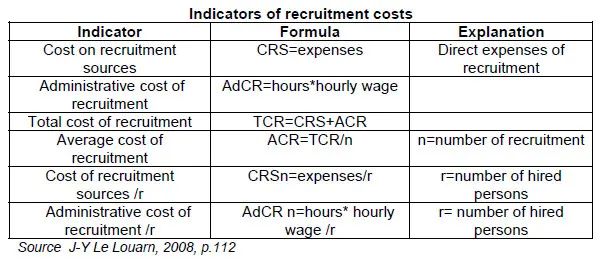
Analysis of resume costs, time costs for accepting/rejecting resumes, costs of sending rejection letters/emails.
Cost indicators for preliminary selection are listed in the table below.
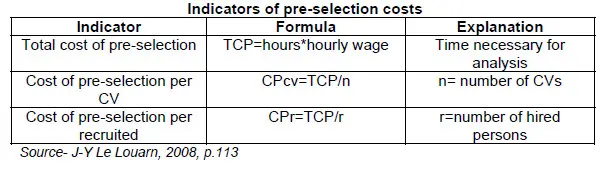
Selection of the best candidates from the preliminary selection using the following techniques: interviews, assessment centers, medical examinations, reference checks (table below).
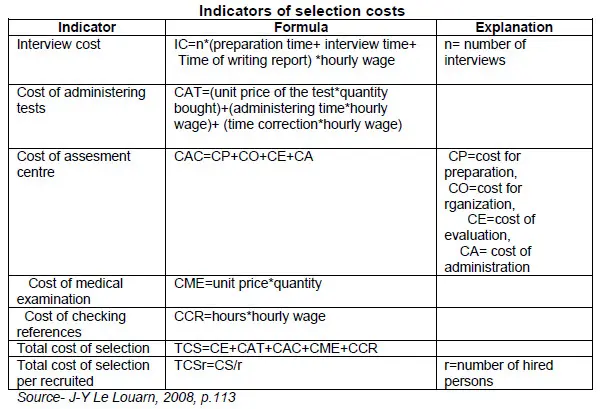
Internal recruiters are an added value for the employer in the areas of salary consulting, market research, candidate feedback, etc., while also helping to build the company's reputation.
Recruitment agencies always have more resources. Large headhunters have extensive networks in specialized markets and also have information about new companies entering these markets. If you choose your headhunters correctly, you will gain inside information about current developments. A truly good headhunter thus becomes a huge asset to your company.
Before selecting and enabling entry into your company, you must wisely choose your recruitment partners and invest time in interviewing them.
Agencies should be your partner in filling positions. Their goal is to save you time and find a candidate who is a perfect fit for you. They must be a trusted partner who shares internal information and market feedback with you. So, when evaluating cooperation with agencies, don't just look at the number of profiles they send you throughout the year, but think about how much money and time it actually costs you.
Many company managers use statistics to quantitatively show them that Agency A sent 100 candidates and Agency B sent only 10 candidates in a year. If they focus solely on the number of candidates, they might stop working with Agency B. However, the time hidden behind these numbers must also be considered.
When you're doing end-of-year statistics on the effectiveness of your agencies, don't just compare them based on the number of profiles they sent you. Also try to think about how much time and money they, and your team, cost you. Finding good candidates in any market requires skill, experience, time, and a good recruiter. If you work in recruitment, you know that finding a good candidate is always difficult, whether in a favorable or unfavorable economic situation.
The time you spend choosing a suitable staffing agency will become a profitable investment, as you will save your time and money during your mutual cooperation. Keep in mind that even though most staffing agencies still work for free (they only receive a “success fee”), they will still cost your company money and time, so choose your agency wisely to help you build a successful company.
The benefits of working with a recruitment agency become apparent especially in the long run, when the costs of the selection process decrease and the demands on your valuable time are reduced.
We will gladly share our experience and prepare customized employee recruitment for you.
Source
LinkedIn.com
Processed by:
TRIGON Consulting
Were you interested in the article? Every month, we bring news from the world of HR to our clients and partners. Join us..

Expertise is the fundamental pillar on which our company stands, and it is also something our partners can rely on one hundred percent. Expertise is what we pride ourselves on and what we constantly develop in our consultants.
More about Trigon Slovenčina Slovenčina
  English